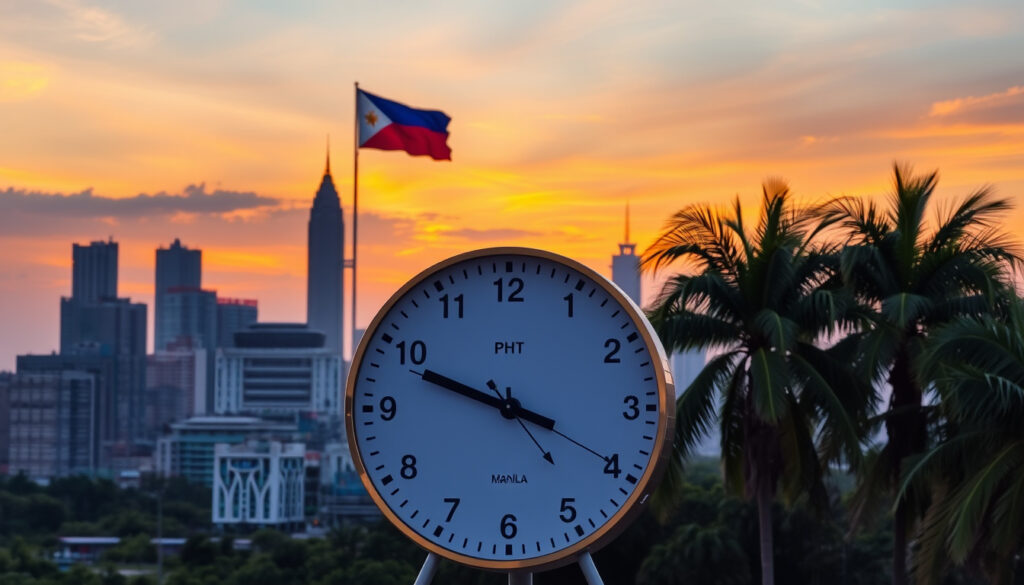
What Time Is It in the Philippines? Manila PHT Now
Whether you’re planning a call with colleagues in Manila, tracking a delivery from Cebu, or just curious what time it is across the Pacific, the Philippines keeps things refreshingly simple. There’s no daylight saving to juggle, no patchwork of regional zones—just one clock for the entire archipelago. That consistency makes it easier than most places to answer the question at hand.
Time Zone: Philippine Standard Time (PHT) · UTC Offset: +08:00 · DST Observed: No · Capital City: Manila · Sunrise/Sunset Info: Available via timeanddate.com
Quick snapshot
- PHT runs at UTC+8, fixed year-round (24 Time Zones)
- No DST adjustments since the 1990s (UTC Time)
- Synchronized across all 7,641 islands (UTC Time)
- US time zones sit 12–15 hours behind PHT (Savvy Time)
- UK and Ireland run 7–8 hours behind the Philippines (World Time Buddy)
- Manila uses IANA zone Asia/Manila (UTC+08:00) (UTC Time Info)
- Metro Manila sets the official reference for the entire country (UTC Time)
- PHT stays fixed—no seasonal shifts ahead (Savvy Time)
- Call windows to Manila remain constant throughout the year (24 Time Zones)
The specification table below summarizes the core parameters for Philippine Time.
| Attribute | Value |
|---|---|
| Official Time Zone | PHT (UTC+8) |
| DST Status | Never observed |
| IANA Identifier | Asia/Manila |
| Main City | Manila |
| Global Rank | UTC+8 standard |
| Coverage | All 7,641 islands |
The implication: this uniformity means travelers and remote workers never need to adjust for internal Philippine time differences.
How many hours ahead is it in the Philippines?
The Philippines operates on Philippine Time (PHT), which is exactly 8 hours ahead of Coordinated Universal Time. That fixed offset means you can always calculate Manila time by adding 8 hours to any UTC reading—nothing adjusts for daylight saving, and nothing shifts by region. According to 24 Time Zones, PHT is one of the well-established UTC+8 designations used worldwide.
The United States presents a larger gap. Depending on which coast you’re comparing to, the Philippines sits 12 to 15 hours ahead. Savvy Time’s converter confirms this wide range: when it’s noon on the US East Coast, it’s already past midnight the next day in Manila. On the West Coast, the lag stretches to 15 hours. No US state shares the same time as the Philippines.
Time difference with United States
- East Coast (EST/EDT): 13–14 hours behind PHT
- West Coast (PST/PDT): 15–16 hours behind PHT
- Central regions: 14–15 hours behind
The implication: scheduling a call between New York and Manila requires planning around a near-full-day gap. Morning in New York means evening in Manila—and vice versa.
For US-based businesses, the 13–15 hour gap makes same-day collaboration nearly impossible. A 7am call in New York lands at 8pm in Manila—too late for most professional settings.
Travelmath calculator insights
Tools like World Time Buddy let you plug in any US city and get the exact offset to Manila instantly. The pattern holds: western states lag further behind than eastern ones, but every US timezone falls at least half a day behind PHT.
What’s the time difference between Ireland and the Philippines?
Ireland presents a more manageable gap. Manila runs 8 hours ahead of Dublin time year-round, with no seasonal fluctuation thanks to Ireland’s own unusual approach to standard time. 24 Time Zones notes that optimal call windows are straightforward to calculate and remain constant regardless of season.
When it’s 9am in Dublin, it’s already 5pm in Manila. The overlap for business hours is narrow: Dublin’s afternoon is Manila’s evening. UTC Time confirms this consistent 8-hour differential applies to the entire Philippine archipelago, from Cebu to Davao.
Dublin to Manila specifics
Dublin operates on Irish Standard Time (IST, UTC+1) during summer and Greenwich Mean Time (GMT, UTC+0) in winter. In both cases, Manila stays 8 hours ahead—Dublin’s clocks shift, but the Philippines doesn’t. This means the numeric gap actually changes by season from Dublin’s perspective, while Manila’s number stays locked at +8 from UTC.
Savvy Time World Clock data
Savvy Time’s PHT-to-UTC converter identifies the best call window from the Philippine side as 4:30pm to 5:30pm PHT, which translates to 8:30am to 9:30am in UTC—right at the start of the Dublin workday. That one-hour window represents the sweet spot for real-time collaboration.
Irish firms working with Manila teams should target that 8:30am–9:30am UTC slot for meetings. Later calls mean asking Philippine colleagues to work past 5pm—a consideration for sustainable -cultural collaboration.
How many hours is the Philippines ahead of the UK?
The UK and Ireland share the same challenge: both sit 8 hours behind the Philippines. World Time Buddy confirms the differential, while Wikipedia’s UTC offset registry lists the Philippines alongside other UTC+8 nations including China, Malaysia, and Singapore.
The complication comes from the UK’s own daylight saving behavior. Britain observes BST (British Summer Time, UTC+1) from late March to late October, shifting to GMT (UTC+0) for the winter months. This means the numerical gap from UK to Philippines actually oscillates between 7 hours in summer and 8 hours in winter—from the UK perspective only.
UK vs PHT offset
From Manila’s perspective, nothing changes. When it’s noon in London during BST, it’s 8pm in Manila. When London shifts back to GMT in October, noon in London becomes 8pm in Manila—same moment, same clock reading in the Philippines.
Seasons impact
The practical effect for UK schedulers: your effective gap shrinks by one hour during British Summer Time. A 9am London call that lands at 5pm Manila in winter lands at 4pm Manila in summer—still outside normal business hours. Year-round, the challenge remains finding shared daytime territory for calls.
How much time is it in the Philippines now?
Philippine Standard Time is fixed at UTC+8 with no exceptions, no adjustments, and no regional variations. UTC Time confirms the offset is UTC+08:00 and has been for years, with daylight saving not observed since the 1990s. The entire country—including Manila, Cebu, Davao, and Quezon City—runs on the same synchronized clock.
For travelers and businesspeople, this uniformity is a genuine advantage. When someone in Manila tells you it’s 3pm, it’s 3pm across every province. There are no internal time zone puzzles to solve, unlike in larger countries where central and regional clocks can differ.
Current PHT display
Live clocks from timeanddate.com and similar services provide real-time PHT readings updated continuously. The conversion formula remains constant: UTC time plus 8 hours equals current Philippine time.
Wikipedia Philippine Standard Time
Wikipedia’s official offset registry lists Philippine Standard Time alongside other UTC+8 jurisdictions, confirming its status as a recognized global standard offset—not a local convention, but an internationally catalogued time designation.
What time is it in the Philippines Manila?
Manila uses the Asia/Manila IANA timezone identifier with a UTC+08:00 offset, confirmed by UTC Time Info. The city’s time matches every other major Philippine population center: Quezon City, Davao, Caloocan, and Cebu all operate on the same synchronized signal, varying only by fractions of a second due to network latency rather than policy.
The lack of internal variation simplifies everything from flight schedules to television broadcasts to business conference calls. When Manila sets a national broadcast schedule, every province receives it at the same local time without adjustment.
Manila specific clock
International converters including Dateful time zone converter let you enter any Manila time and see the equivalent instantly. The platform confirms the instant 8-hour shift characteristic of the zone—no daylight saving curveballs.
Weather and time combo
The Philippines experiences relatively consistent daylight hours year-round given its tropical latitude. timeanddate.com provides sunrise and sunset data for Manila alongside the current clock, useful for travelers managing jet lag or photographers chasing golden hour.
The pattern: Philippine sunrise occurs around 5:30am and sunset around 6:15pm year-round, with minimal seasonal swing compared to temperate zones.
“PST (Philippine) is the abbreviation of Philippine Standard Time. Time zone offset of PST Philippine is UTC+08.”
“Philippine Time is eight hours ahead of the Coordinated Universal Time standard, written as an offset of UTC + 8:00.”
Related reading: First Day of Fall date and time
Frequently asked questions
What day and time is it in the Philippines right now?
The Philippines uses Philippine Time (PHT) at UTC+8. The day always runs ahead of Western Hemisphere time zones—when it’s Monday evening in New York, it’s already Tuesday in Manila.
What time zone is the Philippines?
The Philippines observes PHT (Philippine Time), also abbreviated as PST for Philippine Standard Time. Both refer to UTC+8. The IANA identifier is Asia/Manila.
What time zone is Philippines UTC?
Philippine Time is UTC+8. That means you add 8 hours to any UTC timestamp to get PHT. For example, 12:00 UTC becomes 20:00 (8pm) in Manila.
What is the current time in the Philippines with seconds?
Live time displays on sites like timeanddate.com show PHT down to the second. The seconds tick uniformly across the country.
Is it AM or PM in the Philippines right now?
That depends on the UTC moment you’re converting from. At 00:00 UTC (midnight), it’s 8am in Manila (morning). At 12:00 UTC (noon), it’s 8pm in Manila (evening).
What is 1600 military time in Philippines time?
1600 hours (4:00pm) in UTC converts to midnight (00:00) the next day in PHT. Military time calculations require adding 8 hours and crossing into the following calendar day.
What time is it in the Philippines with weather?
timeanddate.com displays current weather alongside the Manila clock. The Philippines is tropical, so temperature variation is minimal—highs typically range from 88°F to 95°F (31°C to 35°C) year-round.
What is the hottest month in the Philippines?
April and May are typically the warmest months, with temperatures reaching 95°F–104°F (35°C–40°C) in many areas. The wet season runs from June through October, bringing monsoonal rainfall rather than cooler temperatures.
More related posts
 Lauren Hammersley: Age, Husband, Children & Career
 How to Declutter Digital Files – Audit Delete Organize Storage
 The Night Before Christmas – Full Poem, History and Authorship Debate
 Shawn Jackson Funeral Home: Obituaries, Services, Location
 Chicken à la King Recipe: History & 30-Minute Guide
 What Is Potash Used For? Uses, Sources & Safety Tips
 Jon Hamm: Marriage, Sobriety, and Key Facts
 Emma Frost Marvel Rivals – Abilities Breakdown and Tips