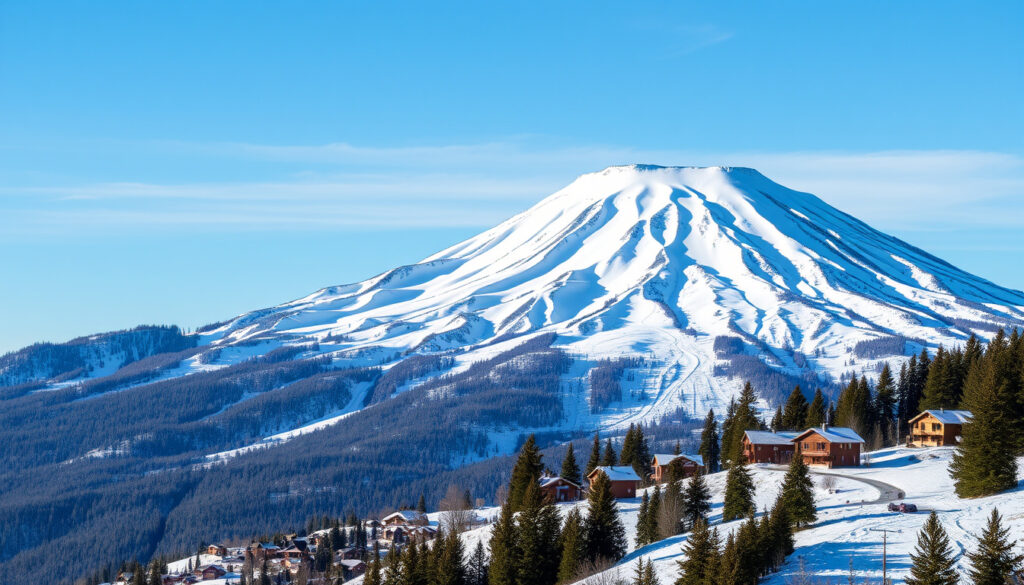
Mount Baker Guide: Volcano, Skiing, and Nearby Towns
There’s something special about a mountain that pulls skiers, hikers, and volcano watchers all at once. Mount Baker, rising 10,781 feet in northern Washington, is one of those rare places where you can chase a world-record snowfall one day and think about ancient eruption history the next.
Elevation: 10,781 ft (3,286 m) · Nearest City: Bellingham, WA (30 mi) · Closest Town: Glacier, WA · Ski Area Base Elevation: 3,500 ft · World Snow Record: 1,140 in (1998–99) · Volcano Status: Active, monitored by USGS
Quick snapshot
- Active stratovolcano with no historical eruptions (USGS Cascades Volcano Observatory)
- Elevation 10,781 ft (3,286 m) — highest peak in the North Cascades (Blackbird Guides) (USGS Cascades Volcano Observatory)
- World single-season snowfall record of 1,140 inches (1998–99) (Mt. Baker Ski Area) (USGS Cascades Volcano Observatory)
- Closest town is Glacier, Washington (Whatcom County Volcano Page)
- Exact date of next eruption — scientific consensus says not imminent but unknown (USGS Cascades Volcano Observatory)
- Whether a future eruption would close the ski area — no contingency plans published (Mt. Baker Ski Area)
- Long-term impact of climate change on ski season length (Wikipedia)
- Last major eruption ~6,600 years ago (USGS Cascades Volcano Observatory)
- Fumarolic activity increased in 1975, prompting intensified monitoring (Wikipedia)
- Ski area opened in 1927; world snowfall record set in 1998–99 (Mt. Baker Ski Area)
- No signs of imminent eruption as of the 2020s (USGS Cascades Volcano Observatory)
- Winter season starts mid-November, subject to snow conditions (Travel + Leisure) (US Forest Service)
- Summer hiking at Artist Point opens once snow clears (typically July) (US Forest Service)
- Guided ski mountaineering programs available May–July (Blackbird Guides) (US Forest Service)
Based on official sources, here are the confirmed statistics for Mount Baker.
| Attribute | Value |
|---|---|
| Elevation | 10,781 ft (3,286 m) (Wikipedia) |
| Nearest City | Bellingham, WA (30 mi) (Wikipedia) |
| Closest Town | Glacier, WA (Whatcom County Volcano Page) |
| Ski Area Base Elevation | 3,500 ft (Mt. Baker Ski Area) |
| Record Snowfall | 1,140 in (1998–99) (Mt. Baker Ski Area) |
| Volcano Type | Active stratovolcano (USGS Cascades Volcano Observatory) |
| Last Major Eruption | ~6,600 years ago (Holocene) (USGS Cascades Volcano Observatory) |
| Monitoring Agency | USGS Cascades Volcano Observatory (USGS Cascades Volcano Observatory) |
What is the closest town to Mount Baker?
Glacier, Washington: The Gateway
- The closest town to the Mount Baker Ski Area is Glacier, an unincorporated community located along the Mount Baker Highway. (Whatcom County Volcano Page)
- Glacier has basic services: a grocery store, gas station, and a few lodging options. For full amenities, head to Bellingham, 30 miles west. (Wikipedia)
Other nearby communities: Maple Falls, Deming
- Maple Falls, about 5 miles west of Glacier, offers additional lodging and a general store. (Wikipedia)
- Deming, further west near the junction with I-5, has larger hotels and is a common base for day-trippers. (Wikipedia)
If you want to be first at the lift, Glacier puts you five minutes from the ski area. But if you value dining and a hot shower after a day on the mountain, Bellingham is the better bet.
The implication: your choice of base camp depends on whether you prioritize proximity to the slopes or access to amenities.
Is Mount Baker still an active volcano?
Volcanic activity and monitoring
- Mount Baker is an active stratovolcano in the Cascade Volcanic Arc. It is monitored by the USGS Cascades Volcano Observatory using seismometers and GPS stations. (USGS Cascades Volcano Observatory)
- Though it hasn’t erupted in historical times, it shows ongoing fumarolic activity — steam vents near Sherman Crater that release volcanic gases. (Alpine Ascents International)
Eruption history
- The last major eruption occurred about 6,600 years ago, producing the Sherman Crater eruptive cycle. (USGS Cascades Volcano Observatory)
- In 1975, increased fumarolic activity raised concern, but no eruption followed. Monitoring was intensified and has continued since. (Wikipedia)
Hazards and preparedness
- Potential hazards include lahars (volcanic mudflows), ashfall, and lava flows. Whatcom County maintains an emergency plan for the volcano. (Whatcom County Volcano Page)
- The USGS says the current risk is low but real — it’s a “quiet” active volcano, not a dormant one. (USGS Cascades Volcano Observatory)
Skiers and hikers get spectacular glaciated terrain exactly because Baker is an active volcano. The same geology that creates epic powder also carries an inherent risk — one that the monitoring network exists to manage, not eliminate.
The pattern: the volcano’s activity is a double-edged sword — it creates the landscape but also requires constant vigilance.
How long is the drive from Vancouver to Mount Baker?
Driving route via Highway 542
- The drive from downtown Vancouver, BC, to the Mount Baker Ski Area takes approximately 2 hours under normal conditions. Route: take the Trans-Canada Highway to the Sumas border crossing, then continue on Highway 542 east. (Travel + Leisure)
- Distance is about 120 km (75 miles). The border crossing at Sumas is typically less busy than Peace Arch, but weekends can still see delays. (Wikipedia)
Alternative transportation: Bus and shuttle options
- No direct public transit exists to the ski area. Some private shuttles operate during winter weekends — check with local operators. (Mt. Baker Ski Area)
- Ridesharing and carpooling are strongly recommended, especially on powder days when parking fills by 9 a.m. (Mt. Baker Ski Area)
Travel time and road conditions
- Winter tires or chains may be required on the Mount Baker Highway. Washington State Patrol often enforces traction rules. (Travel + Leisure)
- Summer drive times are shorter and more predictable; no special equipment needed beyond a standard vehicle. (US Forest Service)
The pattern: Vancouverites have easy access to world-class terrain, but the border adds a variable that Seattle-area drivers don’t face. Plan for an extra 30 minutes at the crossing during peak travel.
Can you do Mount Baker in one day?
Sample itinerary from Seattle
- Leave Seattle by 5:30 a.m.; drive ~2.5 hours via I-5 and Highway 542. Arrive at the ski area by 8 a.m. for first chair. Ski until 3 p.m., then drive back. Total driving: about 5 hours. (Travel + Leisure)
- Round trip from Seattle is about 280 miles. Feasible but long — consider swapping drivers. (Wikipedia)
From Vancouver as a day trip
- From Vancouver, a day trip is even easier: 2 hours each way, no jet lag. Leave by 6:30 a.m., arrive before 9 a.m. (Travel + Leisure)
- Remember to bring passport or enhanced driver’s license for border return. (CBP)
Tips for maximizing time
- Buy lift tickets online in advance to skip the window line. (Mt. Baker Ski Area)
- Pack lunch and snacks; on-mountain dining is limited and can get crowded. (Mt. Baker Ski Area)
Why this matters: a day trip from either city is doable but requires early rising and good road conditions. For most people, an overnight stay in Glacier or Bellingham makes for a more relaxed experience — especially if you want to ski two days.
If you’re crossing the border from Canada, stay informed about current travel advisories — Travel Warnings to USA: Countries Advising Caution & Safety Tips provides an overview of countries advising caution for U.S. travel.
The catch: even with a well-planned day, border delays and weather can turn a quick trip into a long one.
What to do around Mount Baker?
Summer hiking at Artist Point
- Artist Point is the most popular summer destination, offering panoramic views of Mount Baker, Mount Shuksan, and the North Cascades. The trailhead sits at 5,200 feet. (US Forest Service)
- Easy hikes include the 1-mile Artist Ridge Trail; more ambitious routes head toward Table Mountain. Snow lingers into July. (US Forest Service)
Winter skiing and snowboarding at Mt Baker Ski Area
- Mt Baker Ski Area is known for extreme snowfall — the 1998–99 world record of 1,140 inches still stands. The terrain spans 1,000 skiable acres with a vertical drop of 1,500 feet. (Mt. Baker Ski Area)
- No high-speed lifts, but the snow quality and uncrowded slopes more than compensate. The season runs mid-November through mid-April. (Travel + Leisure)
Scenic drives like the Mount Baker Highway
- Highway 542, the Mount Baker Highway, is a National Scenic Byway winding through old-growth forest and alpine meadows. The drive from Glacier to Artist Point is spectacular in late summer. (Wikipedia)
Photography and wildlife viewing
- Black bears, marmots, and bald eagles are common in the area. The Nooksack River supports salmon runs in autumn. (US Forest Service)
- Sunrise and sunset from Artist Point or the ski area parking lot offer classic photo ops of the volcano reflecting in alpine tarns. (Wikipedia)
Mount Baker’s dual identity means you can ski on an active volcano in winter and hike its slopes in summer — but the very glaciers that make the skiing world-class are retreating. For a guide to surviving extreme environments, see Last Breath (2025) – True Story & Survival Guide.
What this means: the same forces that created this playground are slowly reshaping it — a reminder to enjoy it while it lasts.
Three guided programs dominate Mount Baker ski mountaineering — each with a different ratio, length, and price point. Here’s how they compare:
| Guide Service | Duration | Skier-Guide Ratio | Skill Requirement |
|---|---|---|---|
| Blackbird Guides | 3 days | Standard (varies) | Advanced downhill, previous ski touring |
| Alpine Ascents International | 3–4 days | 3:1 | Advanced downhill, ski touring experience |
| RMI Expeditions | 3 days | Not specified | Excellent fitness, advanced skiing, previous ski touring |
The common thread: none of these programs are for beginners. Every guide service emphasizes that the Coleman-Deming route is full glacier ski mountaineering, not resort skiing. (Blackbird Guides)
Upsides
- Unmatched snowfall quality and quantity — consistently among the deepest in North America (Mt. Baker Ski Area)
- Short drive from Vancouver and reasonable from Seattle (Travel + Leisure)
- Year-round recreation: skiing in winter, hiking and climbing in summer (US Forest Service)
- No crowds compared to Whistler or other major resorts (Mt. Baker Ski Area)
Downsides
- Limited lodging near the ski area — book early or stay in Bellingham (Wikipedia)
- No high-speed lifts; long lines on powder days (Mt. Baker Ski Area)
- Volcanic hazard — though low probability, it’s a real active volcano (USGS Cascades Volcano Observatory)
- Backcountry skiing requires advanced skills and specialized gear for glacier travel (Blackbird Guides)
How to plan a Mount Baker ski trip
- Choose your season and style
- Lift-served skiing: mid-November to mid-April at Mt Baker Ski Area. No reservations required for season passes. (Mt. Baker Ski Area)
- Glacier ski mountaineering: May to early July. Requires a guide unless you are an expert. (Blackbird Guides)
- Book lodging and transportation
- For the ski area, stay in Glacier (closest) or Bellingham (30 minutes west). Hotels in Maple Falls are a middle option. (Wikipedia)
- If driving from Vancouver, factor in border crossing time. Check road conditions via Washington State DOT. (Travel + Leisure)
- Prepare your gear
- In-bounds: standard ski/snowboard gear plus a helmet. Gore-Tex shell recommended for wet Northwest snow. (Mt. Baker Ski Area)
- Backcountry/glacier: touring boots, tech bindings, ski crampons, helmet, harness, glacier rope, ice axe, avalanche rescue gear (transceiver, probe, shovel). (Blackbird Guides)
- Consider a guided program for the summit
- Three-day guided trips (see comparison table above) cost around $1,200–$1,500 and include instruction and safety systems. (Alpine Ascents International)
- RMI Expeditions notes that no acclimatization is needed for its Baker program. (RMI Expeditions)
The pattern: careful planning determines whether you’ll be frustrated by the logistics or rewarded by the mountain.
Clarity check: what we know and what we don’t
Confirmed facts
- Mount Baker is an active stratovolcano with no historical eruptions. (USGS Cascades Volcano Observatory)
- The ski area holds the world single-season snowfall record of 1,140 inches. (Mt. Baker Ski Area)
- Glacier, WA is the closest town to the ski area. (Whatcom County Volcano Page)
- Drive from Vancouver takes about 2 hours. (Travel + Leisure)
- Artist Point is accessible for summer hiking from July to October. (US Forest Service)
What’s unclear
- Exact timing of the next eruption — USGS says no warning signs yet but can’t predict long-term. (USGS Cascades Volcano Observatory)
- Whether a future eruption would force indefinite closure of the ski area or damage infrastructure. (Whatcom County Volcano Page)
- How climate change will affect the ski season length — models vary widely. (Wikipedia)
- The exact date the ski area opens each year — it’s condition-dependent. (Travel + Leisure)
- Long-term viability of the nearby towns if volcanic activity increases. (Whatcom County Volcano Page)
The catch: uncertainty is baked into both the volcano and the snowpack — plan accordingly, but don’t let it stop you from going.
Voices from the mountain
“Mount Baker is a heavily glaciated and active but quiet stratovolcano.”
“Baker has more than 12 active glaciers covering an area exceeding 20 square miles.”
— Alpine Ascents International
“The best time for ski mountaineering on Mount Baker is May through early July — the sweet spot for weather, corn snow, and access.”
“Mount Baker Ski Area operates under a permit granted by the United States Forest Service on the Mt. Baker-Snoqualmie National Forest.”
— Mt. Baker Ski Area, official site
The pattern: each source reinforces the same truth — this is serious terrain that demands respect.
The dual nature of Mount Baker is not a gimmick — it’s the essence of the place. An active volcano that hasn’t erupted in 6,600 years, it gives skiers and hikers world-class terrain precisely because of its volcanic past. The risk is real but managed, the snow is legendary but unpredictable, and the access is easy but requires planning. For skiers from Vancouver, the choice is clear: embrace the short drive and the deep snow, but respect the volcano and the glacier. Or spend the extra money for a guided program and experience the summit — just don’t expect a lift to the top.
skitalk.com, facebook.com, travelandleisure.com, mtbaker.us, alpineinstitute.com
For a deeper look at the mountain’s dual identity as a scientific monitoring site and a skier’s paradise, check out this Mount Baker volcano and skiing guide.
Frequently asked questions
How far is Mount Baker from Seattle?
Mount Baker Ski Area is approximately 140 miles from downtown Seattle, about a 2.5-hour drive without traffic. From Vancouver, BC, it’s about 75 miles (2 hours) via the Sumas border crossing. (Travel + Leisure)
Is Mount Baker open for skiing in summer?
The Mt Baker Ski Area is generally closed from mid-April through mid-November. Summer recreation focuses on hiking at Artist Point and backcountry skiing on the glaciers (May–July). (Mt. Baker Ski Area)
What is the elevation of the Mount Baker Ski Area?
The base elevation of the lift-served ski area is 3,500 feet, with a summit elevation of 5,000 feet, giving a vertical drop of 1,500 feet. (Mt. Baker Ski Area)
Are there camping facilities near Mount Baker?
Yes, there are several campgrounds along Highway 542, including Douglas Fir Campground and Silver Fir Campground, operated by the US Forest Service. Reservations are recommended in summer. (US Forest Service)
Can I hike to the summit of Mount Baker without a guide?
Summiting Mount Baker is a serious glacier climb requiring crevasse rescue skills, rope travel, and avalanche awareness. Most climbers hire a guide. RMI Expeditions and Alpine Ascents both offer summit trips. (RMI Expeditions)
What are the road conditions like on the Mount Baker Highway in winter?
Highway 542 is plowed regularly but can be icy or snow-covered. Winter tires or chains are often required. Check Washington State DOT for conditions before heading up. (Travel + Leisure)
Is there a webcam for Mount Baker?
Yes, the Mt Baker Ski Area maintains a webcam at the base area (mtbaker.us/webcam). It’s a reliable way to check current snow and weather conditions.
What is the nearest airport to Mount Baker?
The closest major airport is Bellingham International Airport (BLI), about 30 miles west of the ski area. Seattle-Tacoma International Airport (SEA) is 120 miles south, about a 2.5-hour drive. (Wikipedia)
More related posts
 Why Is the TSX Down Today? Live Updates & Key Reasons
 Body Mass Index Calculator: Adults & Seniors
 Kenny U-Pull Sherbrooke: Junk Cars & Used Auto Parts
 Best Exercises for Coordination: Drills for Balance & Agility
 Patrick Dovigi: From Hockey to Billion-Dollar Waste Empire
 Raul Julia: Cause of Death and Lasting Legacy
 Maple Leafs vs Avalanche – Avalanche Win 4-1 on Jan 25
 Sport Chek Thunder Bay: Store, Online Orders & Ownership