The Night Before Christmas – Full Poem, History and Authorship Debate
“A Visit from St. Nicholas,” universally recognized by its opening line “‘Twas the night before Christmas,” stands as the most influential holiday poem in English literature. First printed in 1823, the 56-line verse established the visual and behavioral template for the modern Santa Claus, introducing eight named reindeer and the iconic chimney descent that continues shaping global Christmas iconography.
Originally published anonymously in an upstate New York newspaper, the work emerged during a pivotal moment in American cultural history. The early 19th century witnessed Christmas transforming from a raucous public festival into a domestic, child-centered celebration. The poem’s depiction of a tranquil household anticipating a magical visitor captured this shift perfectly, resonating with emerging middle-class values while creating imagery now replicated in billions of annual celebrations worldwide.
Despite its ubiquity, the poem’s origins remain contested. Two distinct authorship claims—one by a prominent Hebrew scholar, the other by a Revolutionary War veteran’s descendants—have generated decades of scholarly debate. The following examination presents the complete text, traces the publication timeline, and evaluates the evidence surrounding its disputed creation.
Who Wrote ‘Twas the Night Before Christmas?
Clement Clarke Moore (disputed)
December 23, 1823
56 lines (anapestic tetrameter)
Public domain
- Anonymous debut: The poem first appeared without attribution in the Troy Sentinel newspaper of Troy, New York.
- Moore’s claim: Clement Clarke Moore, a professor of Oriental and Greek literature, publicly acknowledged authorship in 1844 when including the work in his personal poetry collection.
- Livingston challenge: Beginning in the early 2000s, descendants of Henry Livingston Jr., a Dutch-American poet and gentleman farmer, advanced alternative authorship claims supported by linguistic analysis.
- Stylistic debate: Computational linguistic studies comparing the poem’s meter and vocabulary against both candidates’ confirmed works have yielded inconclusive results, with some analyses favoring Livingston’s writing patterns.
- Manuscript absence: No original holograph manuscript definitively links either candidate to the 1823 text, complicating definitive attribution.
- Cultural footprint: The work has generated billions of impressions through recitations, printings, and adaptations since its debut.
| Original Title | A Visit from St. Nicholas |
|---|---|
| Vernacular Title | ‘Twas the Night Before Christmas |
| First Publisher | Troy Sentinel (Troy, New York) |
| Initial Print Date | December 23, 1823 |
| Authorship Claimants | Clement Clarke Moore; Henry Livingston Jr. (posthumous) |
| Meter | Anapestic tetrameter |
| Rhyme Scheme | AABB (couplets) |
| Current Status | Public domain worldwide |
What Is ‘Twas the Night Before Christmas About?
Narrative Arc
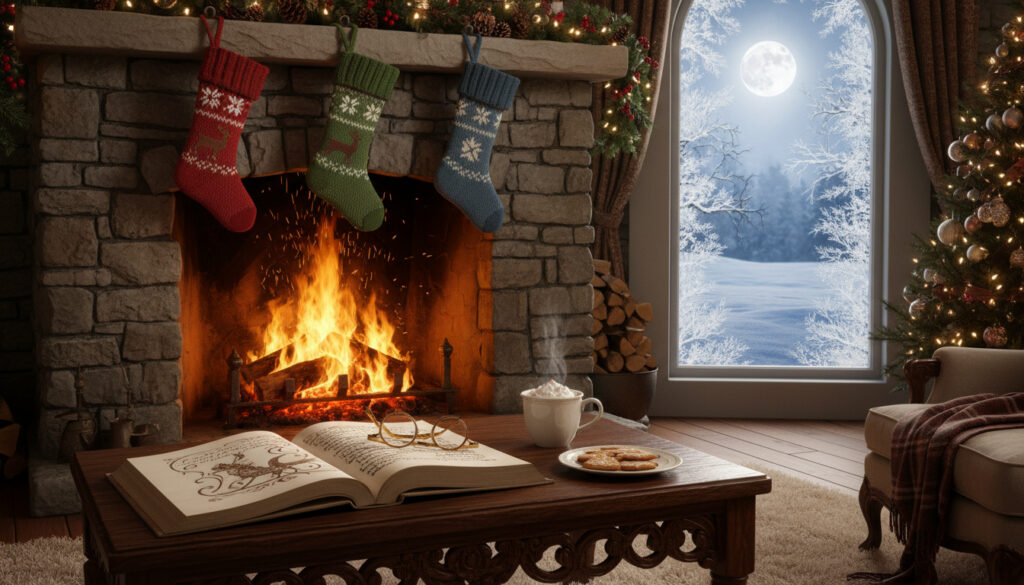
The poem unfolds through the eyes of a father awakened on Christmas Eve. The narrator describes hearing clatter on the lawn, witnessing the arrival of a miniature sleigh pulled by eight tiny reindeer, and observing the visitor’s physical descent down the chimney. St. Nicholas, depicted as a “right jolly old elf” dressed in fur, fills the household stockings before departing with a shouted farewell of “Happy Christmas to all, and to all a good night!”
Innovations in Christmas Lore
Prior to this publication, St. Nicholas was depicted variously as a tall, gaunt figure or a bishop-like character. This text crystallized the image of a chubby, benevolent gift-giver with a white beard and magical transportation. The specific naming of eight reindeer—Dasher, Dancer, Prancer, Vixen, Comet, Cupid, Donner, and Blitzen—originated here and became canonical.
The poem employs anapestic tetrameter, a rhythmic pattern featuring four beats per line with unstressed-unstressed-stressed syllable groupings. This meter creates the galloping, musical quality that makes the verse memorable for children and adults alike.
Full Text of the Poem
The complete 56-line text, consistently presented across archival sources, resides in the public domain. The following version reflects the standard transcription used by academic institutions:
'Twas the night before Christmas, when all through the house
Not a creature was stirring, not even a mouse;
The stockings were hung by the chimney with care,
In hopes that St. Nicholas soon would be there;

The children were nestled all snug in their beds,
While visions of sugar-plums danced in their heads;
And mamma in her ‘kerchief, and I in my cap,
Had just settled our brains for a long winter’s nap,

When out on the lawn there arose such a clatter,
I sprang from the bed to see what was the matter.
Away to the window I flew like a flash,
Tore open the shutters and threw up the sash.

The moon on the breast of the new-fallen snow
Gave the lustre of mid-day to objects below,
When, what to my wondering eyes should appear,
But a miniature sleigh, and eight tiny reindeer,

With a little old driver, so lively and quick,
I knew in a moment it must be St. Nick.
More rapid than eagles his coursers they came,
And he whistled, and shouted, and called them by name:

"Now, Dasher! now, Dancer! now, Prancer and Vixen!
On, Comet! on, Cupid! on, Donner and Blitzen!
To the top of the porch! to the top of the wall!
Now dash away! dash away! dash away all!"

As dry leaves that before the wild hurricane fly,
When they meet with an obstacle, mount to the sky;
So up to the house-top the coursers they flew,
With the sleigh full of toys, and St. Nicholas too.

And then, in a twinkling, I heard on the roof
The prancing and pawing of each little hoof.
As I drew in my head, and was turning around,
Down the chimney St. Nicholas came with a bound.

He was dressed all in fur, from his head to his foot,
And his clothes were all tarnished with ashes and soot;
A bundle of toys he had flung on his back,
And he looked like a pedler just opening his pack.

His eyes—how they twinkled! his dimples, how merry!
His cheeks were like roses, his nose like a cherry!
His droll little mouth was drawn up like a bow,
And the beard on his chin was as white as the snow;

The stump of a pipe he held tight in his teeth,
And the smoke, it encircled his head like a wreath;
He had a broad face and a little round belly
That shook when he laughed, like a bowl full of jelly.

He was chubby and plump, a right jolly old elf,
And I laughed when I saw him, in spite of myself;
A wink of his eye and a twist of his head
Soon gave me to know I had nothing to dread;

He spoke not a word, but went straight to his work,
And filled all the stockings; then turned with a jerk,
And laying his finger aside of his nose,
And giving a nod, up the chimney he rose;

He sprang to his sleigh, to his team gave a whistle,
And away they all flew like the down of a thistle.
But I heard him exclaim, ere he drove out of sight—
"Happy Christmas to all, and to all a good night!"
Publication History and Timeline
The Troy Sentinel served a small but literate population in upstate New York. The poem’s appearance in a regional newspaper rather than a literary journal suggests it was initially considered light verse for family entertainment rather than serious poetry.
- : According to Moore family tradition, Clement Clarke Moore composes the poem for his children during a winter sleigh ride.
- : The Troy Sentinel publishes the poem anonymously, allegedly submitted by an acquaintance of the Livingston family who had seen the manuscript.
- : The work appears in The New-York Book of Poetry with Moore credited as author.
- : Moore includes the poem in his collection Poems, publicly claiming authorship and establishing the textual standard.
- : Researchers and Livingston descendants present linguistic evidence suggesting Henry Livingston Jr. may have written the poem as early as 1808.
Authorship Certainty: What We Know and What Remains Debated
| Established Information | Remaining Uncertainties |
|---|---|
| First published December 23, 1823 in Troy Sentinel | Exact date of composition (1822 vs. earlier) |
| Anonymous initial publication | Definitive identity of original author |
| Clement Clarke Moore claimed authorship in 1844 | Whether Moore transcribed family folklore or composed original verses |
| Henry Livingston Jr. died in 1828 without claiming credit | Extent of Livingston family storytelling tradition |
| Manuscripts exist in Moore’s hand from after 1823 | Absence of pre-1823 Livingston manuscripts |
Cultural Context and Lasting Legacy
The poem’s publication coincided with evolving American Christmas traditions. In the early 19th century, the holiday was gaining recognition as a family-centered occasion rather than a public festival marked by rowdiness. The domestic scene depicted—a quiet house, sleeping children, parental anticipation—resonated with emerging middle-class values and helped codify the modern gift-giving ritual.
Despite popular belief, the poem does not mention Santa Claus wearing red specifically. The description notes he is “dressed all in fur,” leaving color interpretations to later illustrators such as Thomas Nast and 20th-century advertising artists.
The text has been translated into hundreds of languages and adapted into films, musicals, and animated specials. Educational institutions continue using the poem to teach anapestic meter and cultural history. Its depiction of Santa Claus influenced Thomas Nast’s Harper’s Weekly illustrations and, subsequently, the global visual identity of Christmas. The poem’s enduring appeal creates shared cultural experiences comparable to international sporting events such as the FIFA World Cup European Qualifiers Games.
Primary Sources and Notable Quotations
‘Twas the night before Christmas, when all through the house
Not a creature was stirring, not even a mouse;
The stockings were hung by the chimney with care,
In hopes that St. Nicholas soon would be there;— Opening stanza, A Visit from St. Nicholas, Troy Sentinel, 1823
He was chubby and plump, a right jolly old elf,
And I laughed when I saw him, in spite of myself;
A wink of his eye and a twist of his head
Soon gave me to know I had nothing to dread;— Stanza 12, describing the modern Santa archetype
Summary
The poem known as “‘Twas the Night Before Christmas” stands as a foundational text of holiday literature, regardless of whether Clement Clarke Moore or Henry Livingston Jr. penned its lines. Its 1823 debut in the Troy Sentinel introduced enduring iconography—eight named reindeer, a fur-clad elf, and chimney descent—that continues shaping global Christmas celebrations. As a public domain work documented by poetry archives, it remains freely accessible for adaptation and recitation, much like celebrations marked on National Girlfriend Day 2025.
Frequently Asked Questions
Is ‘Twas the Night Before Christmas in the public domain?
Yes. Published in 1823, the poem predates modern copyright law and resides in the public domain worldwide, allowing free reproduction and adaptation.
How many reindeer are named in the poem?
The text names eight reindeer: Dasher, Dancer, Prancer, Vixen, Comet, Cupid, Donner, and Blitzen.
Did Clement Clarke Moore admit he wrote it?
Moore publicly claimed authorship in 1844 when including the poem in his personal collection, though some scholars dispute this attribution based on stylistic analysis.
Where was the poem first published?
It debuted anonymously in the Troy Sentinel newspaper of Troy, New York, on December 23, 1823.
What was the original title?
The poem first appeared under the title “A Visit from St. Nicholas,” with the “‘Twas the night before Christmas” opening line later becoming the popular title.
Who is Henry Livingston Jr.?
A Dutch-American poet who died in 1828; his descendants claim he composed the poem as early as 1808, though no manuscript evidence from that period confirms this.
How long is the poem?
The complete work contains 56 lines arranged in 14 quatrains following an AABB rhyme scheme.
More related posts
 Emma Frost Marvel Rivals – Abilities Breakdown and Tips
 Rogers Red World Elite Mastercard: Benefits, Fees & Rewards
 House of the Dragon Season 3: Release Date, Delay & News
 Travel Warnings to USA: Countries Advising Caution & Safety Tips
 Raul Julia: Cause of Death and Lasting Legacy
 Registry of Joint Stocks: Login, Search, Renewal Guide
 Tina Fey Biography: Ethnicity, Husband, and Net Worth
 Sid Wilson: Slipknot DJ’s Accident, Split, and Six Fingers