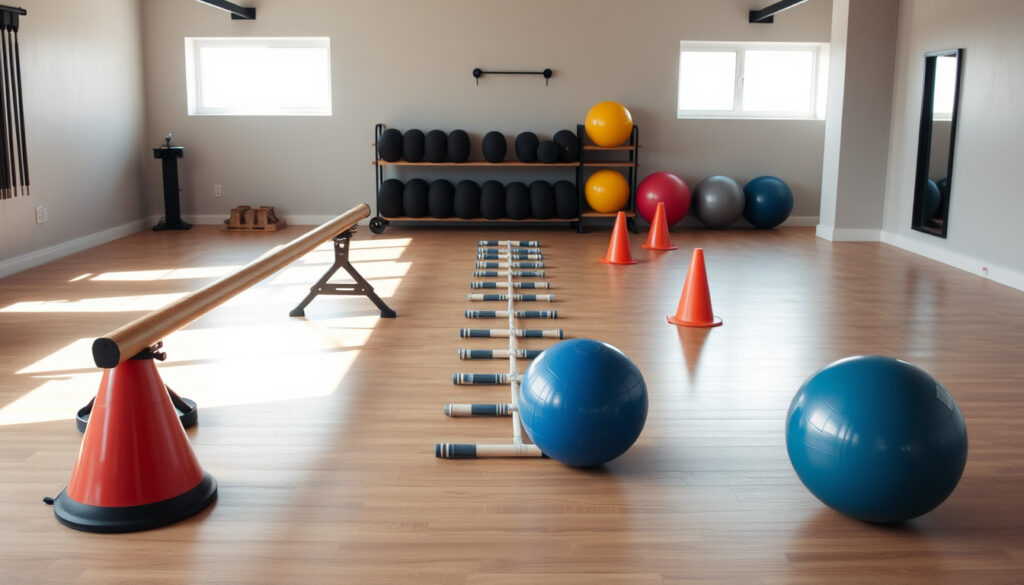
Best Exercises for Coordination: Drills for Balance & Agility
Dropping coffee cups, tripping on uneven pavement, struggling to catch a ball — coordination slips without you noticing, until something goes wrong. The good news: a few targeted drills done consistently at home can sharpen the connection between your brain and body, whether you’re a kid building foundational skills or a senior working to stay steady on your feet. Health organizations like the NHS and researchers backed by the British Medical Journal have made it clear that specific exercises don’t just feel good — they work.
Hinge Health recommends: 4 exercises · GMB Fitness lists: 12 drills · NHS provides: balance exercises · Physio-pedia covers: fine and gross motor skills · Third Age Fitness offers: 5 exercises in 5 minutes
Quick snapshot
- Jump rope and tai chi improve coordination per Hinge Health
- Coordination exercises reduce falls by almost 40% in older adults per BMJ review (Hinge Health)
- NHS balance drills are equipment-free home options (NHS)
- How exactly coordination gains transfer to other motor skills
- Optimal dosage (sets, reps, frequency) specific to age groups under 4
- Long-term retention of coordination improvements after stopping exercise
- 2019: European Journal Study on stability exercises published (Hinge Health)
- 2025-04-24: Healthline Coordination for Seniors article written (Healthline)
- 2026-03-30: Healthline Balance Exercises article updated (Healthline)
- At-home routines growing as physiotherapists recommend no-equipment drills
- Age-specific programs targeting kids, adults, and seniors with tailored progressions
- Integration of coordination training into fall-prevention protocols
| Label | Value |
|---|---|
| Core skills | Fine motor: writing, drawing; Gross motor: walking, running |
| Top source exercises | Hinge Health: 4 targeted |
| Home options | NHS balance drills |
| Quick routines | Third Age: 5 in 5 minutes |
| Fall reduction | 40% (BMJ review via Hinge Health) |
| Heel-to-toe walk steps | At least 5 steps |
| One leg stand duration | 5–10 seconds, 3 times per side |
| Rock the boat hold | Up to 30 seconds |
What exercises improve coordination?
Coordinating your body’s movements is really about training your brain to send faster, clearer signals to your muscles. Activities like jump rope, tai chi, swimming, and dancing hit multiple systems at once — balance, rhythm, spatial awareness — making them particularly effective for building that brain-body connection. Hinge Health recommends targeting these through structured drills rather than just hoping daily movement covers it.
Jump rope drills
- Start with 30-second intervals, building to 2 minutes with no misses
- Progress to crossing patterns and side swings once basic jumping is smooth
- Benefits: rhythm timing, hand-foot coordination, cardiovascular endurance
Tai chi movements
- Slow, continuous sequences that demand constant weight shifting and focus
- One study published in the New England Journal of Medicine found tai chi more helpful for coordination than stretching or resistance training among patients with Parkinson’s disease (Hinge Health)
- Best for: seniors, anyone with balance deficits, Parkinson’s patients
Swimming strokes
- Alternating arm movements while maintaining kick rhythm develops bilateral coordination
- Flip turns and stroke counting add cognitive load, strengthening motor planning
Dancing routines
- Any dance style that requires step sequences (salsa basics, line dancing) works
- Group classes add social engagement, which research links to better adherence
The implication: picking one rhythmic, full-body activity you enjoy means you’re more likely to stick with it — and consistency is what builds real coordination gains, not perfection in any single session.
What are 5 exercises for coordination?
If you need a focused routine without browsing dozens of options, five well-chosen drills can cover the main coordination bases: rhythm, balance, agility, and motor planning. Big Leaps Pediatric Therapy recommends starting with seated versions for beginners before progressing to standing. The Hinge Health framework builds from there with targeted strength-and-balance moves.
Balloon tossing
- Keep a balloon airborne using only your hands or feet
- Start with one balloon, progress to two once tracking is automatic
- Benefits: visual tracking, reaction time, hand-eye coordination for kids and adults
Juggling
- Begin with two balls in a figure-8 motion before adding the third
- Use soft scarves first if hand-eye coordination is still developing
- Research from Hinge Health notes that juggling activates multiple brain regions simultaneously
Small ball tossing
- Toss a tennis ball against a wall and catch with the opposite hand
- Alternate catching zones (right side, left side, overhead) to build unpredictability handling
- Cross Taps exercise works on crossing midline, core strength, and coordination; start seated (Big Leaps Pediatric Therapy)
Jump rope drills
- Basic two-foot jump for 30 seconds, then 10 seconds rest; repeat 5 times
- Progress to alternating foot patterns once rhythm is stable
Target practice
- Set up a bucket or target hoop; toss beanbags or soft balls for accuracy
- Vary distances and introduce movement (toss while stepping sideways) as accuracy improves
What are the best exercises for coordination for kids?
Children develop coordination in layers — starting with fine motor skills like holding a crayon, then moving to gross motor skills like running and hopping. The key for parents and caregivers is choosing activities that feel like play while still demanding the brain-body link that coordination requires. According to Miracle Recreation, balance and coordination develop fastest when kids face just enough challenge to stay engaged without becoming frustrated.
Fine motor skills activities
- Writing and drawing: grip control builds finger coordination foundational to everything else
- Buttoning shirts or zipping jackets: small, precise hand movements with a functional payoff
- Blowing bubbles: breath control meets visual tracking in a low-pressure activity (Physio-pedia)
- Jumping Jacks build coordination and endurance for kids aged 4 and older (Big Leaps Pediatric Therapy)
Gross motor games
- Hopscotch improves bilateral coordination and motor planning (Crit USA)
- Wheelbarrow walking builds arm balance with adult support (Miracle Recreation)
- Crab walking develops bilateral coordination and core strength (Miracle Recreation)
- Standing on one foot challenges balance; progress without wall support once mastered (Miracle Recreation)
- Ski Hops mimic skiing motions to boost kids’ dynamic balance (YouTube: 8 SUPER FUN BALANCE AND COORDINATION EXERCISES)
Kids who build solid coordination foundations early show better posture, fewer injuries during sports, and improved handwriting. The window for developing certain motor pathways narrows after age 10 — early investment pays long-term dividends.
What are the best exercises for coordination for seniors?
For older adults, coordination isn’t just about performance — it’s a safety issue. Feeling unsteady when walking or rising from a chair can chip away at confidence and independence. Healthline reports that a medically reviewed program combining balance drills, strength work, and gentle movement reduces fall risk meaningfully. One Hinge Health analysis of BMJ research found that exercise programs including coordination exercises reduce rates of falls among older adults by almost 40%.
Balance-focused moves
- Tai chi improves coordination for seniors by enhancing proprioception (Sunflower Communities)
- Yoga builds stability and coordination through held poses (Sunflower Communities)
- Tree Pose strengthens legs and core for seniors (Healthline)
- Rock the boat involves lifting one foot diagonally and holding up to 30 seconds (Healthline)
- One leg stand: hold 5–10 seconds, repeat 3 times per side (Healthline)
Low-impact drills
- Fast sit-to-stands improve strength and reduce fall risk in seniors (Hinge Health)
- Heel-to-toe walk: at least 5 steps, use wall for support initially (Healthline)
- Sideways walking for seniors: 10 steps each way (Healthline)
- Strength training like squats and lunges enhances senior stability (Sunflower Communities)
- Standing on one leg or heel-to-toe walking are simple home balance exercises for seniors (Sunflower Communities)
Seniors who focus only on strength training miss the proprioception and reactive balance gains that come from tai chi and single-leg stands. A balanced program addressing both domains cuts fall risk more effectively than either approach alone.
What are coordination exercises at home?
One of the biggest barriers to consistent coordination training is believing you need a gym — or any equipment at all. The NHS (the UK’s National Health Service) publishes free, equipment-free balance exercises specifically designed for home practice, and Healthline medically reviews similar routines updated as recently as March 2026. The following drills require only your body and a clear floor space.
Heel-to-toe walk
- Walk forward in a straight line, placing the heel of one foot directly in front of the toes of the other
- Walk forward three steps then backward using the same heel-to-toe placement (YouTube: Seniors Improve Coordination)
- Start near a wall for safety; progress to unsupported walking once stable
One-leg stand
- Stand on one leg while maintaining a slight knee bend for stability
- Hold for 5–10 seconds, repeat 3 times per side (Healthline)
- Progress by closing your eyes once floor standing feels controlled
Sideways walking
- Stand with feet together, step sideways slowly with control
- Simple grapevine: cross right foot over left for mobility (NHS)
- Take 10 steps each direction, using a counter or wall for support initially
Tightrope walk
- Place a line on the ground; walk along it as if on a tightrope
- Walk 15 steps per set, 3–5 sets total (Healthline)
- Focus on a fixed point ahead to reduce swaying
These NHS and Healthline-reviewed home exercises require no equipment, no subscription, and no travel. Fifteen minutes a day of heel-to-toe walking, one-leg stands, and sideways steps can meaningfully improve balance within four weeks of consistent practice.
How to do coordination exercises: step-by-step
Following a structured approach ensures you’re progressing safely while building genuine coordination rather than just going through motions. Hinge Health and Lake County Physical Therapy both recommend starting with static balance before advancing to dynamic movement.
A 2019 European Journal study cited by Hinge Health found that 20 minutes of stability exercises twice weekly for 12 weeks improves balance in heart disease patients. That 12-week window appears repeatedly in the research as a meaningful improvement threshold.
Start with a warm-up (2–3 minutes)
March in place, arm circles, and gentle ankle rotations prepare your nervous system for balance work. Cold muscles respond less precisely, so a brief warm-up reduces injury risk and improves performance during coordination drills.
Master static balance first
Begin with two-foot standing near a wall or chair. Progress to one-leg stands holding 5–10 seconds per side (Healthline). Flamingo stands work for older adults, kids, and athletes alike (Healthline). Only move to dynamic balance once static holds feel stable for at least 10 seconds.
Add dynamic balance drills
Heel-to-toe walking, sideways grapevine steps, and step-back jacks introduce movement while demanding balance. For kids, try lateral step reach to enhance side-to-side coordination (YouTube: 8 SUPER FUN BALANCE AND COORDINATION EXERCISES). For seniors, tree pose builds leg and core strength during single-leg stance (Healthline).
Incorporate rhythmic, full-body activities
Jump rope, swimming strokes, or dancing add cognitive layers — rhythm, anticipation, and reactive timing — that isolated balance drills don’t address. Tai chi outperforms stretching or resistance training specifically for Parkinson’s coordination (Hinge Health).
Cool down with gentle movement (2–3 minutes)
Slow walking, deep breathing, and light stretching prevents stiffness and signals to your nervous system that the coordination session is complete. Consistency over 12 weeks produces measurable balance improvements according to the Hinge Health analysis of clinical data.
Clarity: what’s confirmed vs. uncertain
Confirmed
- Jump rope and tai chi improve coordination per Hinge Health
- Coordination exercises reduce falls by almost 40% in older adults per BMJ review (Hinge Health)
- Tai chi outperforms stretching or resistance training for Parkinson’s coordination (Hinge Health)
- NHS balance exercises (sideways walking, grapevine, heel-to-toe) are equipment-free home options (NHS)
- Cross Taps, tightrope walk, and one-leg stand have specific rep/duration benchmarks from medically reviewed sources (Big Leaps Pediatric Therapy; Healthline)
Uncertain
- How precisely coordination gains from one activity transfer to untrained skills
- Optimal rep/sets for children under age 4, where data is sparse
- Long-term retention rates after stopping a coordination program
- Whether apps and digital trainers produce measurable coordination gains comparable to in-person instruction
What experts say
Exercise programs that include coordination exercises reduce rates of falls among older adults by almost 40%, according to a review published in the British Medical Journal.
— Hinge Health (Health Resource citing BMJ)
One study published in the New England Journal of Medicine found tai chi more helpful for coordination than stretching or resistance training among patients with Parkinson’s disease.
— Hinge Health (Expert citing NEJM)
These simple balance exercises can be done at home to help improve your health and mobility.
— NHS (National Health Service of the United Kingdom)
The pattern across these sources is consistent: structured, repetition-based movement programs consistently outperform casual activity for coordination outcomes. The 40% fall reduction figure from the BMJ review is the most compelling number in the field, and it applies specifically to older adults — a population where even modest improvements translate directly to quality of life and independence.
Related reading: lunge exercise · high cortisol symptoms
Seniors can particularly benefit from low-impact chair exercises for seniors that build strength and balance safely without needing to stand for extended periods.
Frequently asked questions
What is coordination?
Coordination is your body’s ability to move different parts together smoothly and accurately — linking what your brain decides with what your muscles do. It involves balance, rhythm, spatial awareness, and reaction time working in concert.
Why is coordination important?
Good coordination reduces injury risk, improves athletic performance, and maintains independence as you age. Research shows coordination exercises cut fall rates among older adults by nearly 40% per the BMJ review cited by Hinge Health.
How often should you do coordination exercises?
Aim for 15–20 minutes of balance and coordination work 2–3 times per week. A clinically reviewed 12-week program from Hinge Health showed measurable balance improvements in heart disease patients doing stability exercises twice weekly.
Can coordination improve with age?
Yes. While some motor processing slows with age, targeted balance and coordination exercises build new neural pathways. Tai chi specifically outperforms stretching for Parkinson’s patients, proving that improvement remains possible well into later life (Hinge Health).
What causes poor coordination?
Poor coordination can stem from muscle weakness, sensory processing issues, neurological conditions, medication side effects, or simply inactivity. A physiotherapist can identify underlying causes and recommend appropriate exercises.
Are there apps for coordination training?
Several apps offer guided balance and coordination workouts, though research on their effectiveness compared to in-person physiotherapy remains limited. Apps work best as supplements to, not replacements for, a structured program from a qualified professional.
How does balance relate to coordination?
Balance is a component of coordination — it’s what happens when your body manages its center of gravity. Many coordination exercises (heel-to-toe walks, single-leg stands, tai chi) explicitly train balance as their foundation.
For seniors who want to stay independent and active, the path is clear: pick two or three NHS-recommended home exercises — sideways walking, heel-to-toe steps, and one-leg stands — and do them consistently three times a week. For parents raising active kids, fun coordination games like hopscotch, balloon toss, and jump rope build motor foundations that pay dividends in sports, handwriting, and everyday confidence.
More related posts
 FIFA World Cup European Qualifiers Games – 2026 Schedule, Results & Teams
 How Long Does It Take to Renew a Passport in Canada – 2024 Processing Times
 10 Celsius to Fahrenheit – Exact 50°F Formula & Table
 The Night Before Christmas – Full Poem, History and Authorship Debate
 How to Declutter Digital Files – Audit Delete Organize Storage
 Murder in a Small Town – Famous Cases, Stats & Insights
 Roll Up The Rim 2025 – How To Enter And Win Prizes
 Maple Leafs vs Avalanche – Avalanche Win 4-1 on Jan 25