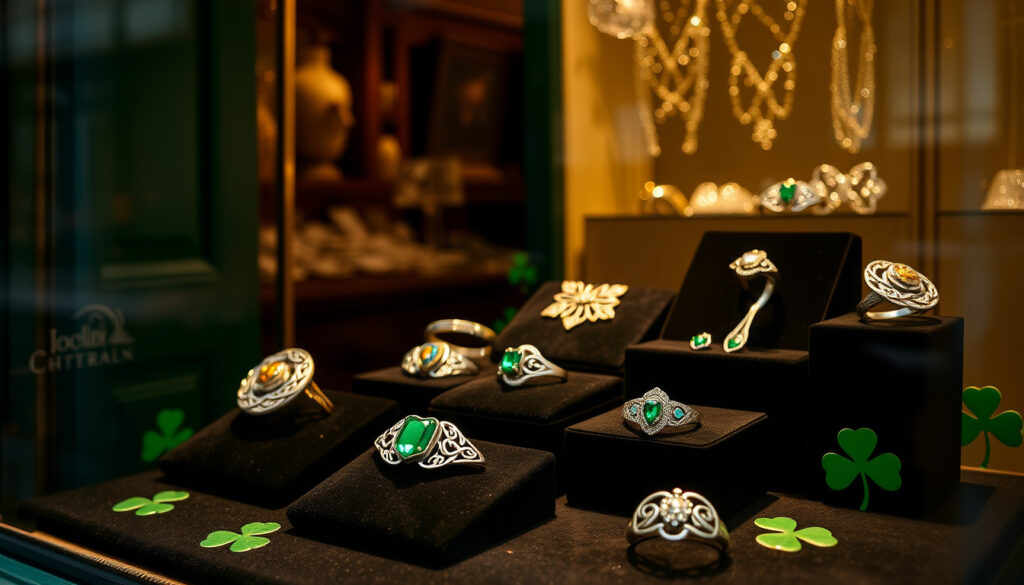
Jewelry Store Near Me: Best Irish Shops in Dublin & Beyond
Irish jewellery shops have been turning out Claddagh rings, Connemara marble pendants, and Trinity Knot designs for generations — blending centuries-old craft with a distinctly Irish aesthetic you won’t find elsewhere. Whether you’re hunting for a gold engagement ring on Grafton Street or a sterling silver piece at St Stephen’s Green, the shops in this guide cover the full spectrum of budgets and styles.
Fields the Jeweller established: 1979 · McCormack Celtic Jewelry since: 1963 · Connemara Marble origin: Ireland only · Top stores in: Dublin, Ennis, Killarney · Free shipping from: celticdublin.com
Quick snapshot
- R & C McCormack has operated on Grafton Street since 1963 (Visit Dublin)
- Connemara Marble is quarried exclusively in County Galway, Ireland (Visit Dublin)
- How pricing varies between independent shops and chains across Irish cities
- Whether standard haggling customs apply consistently at all jewellers
- Solvar founded 1941 · McCormack 1963 · Celtic Spirit 1988 — decades of Dublin craftsmanship
- Online ordering with worldwide delivery makes Irish jewellery accessible beyond the island
| Label | Value |
|---|---|
| Fields established | 1979 |
| Celtic Jewelry since | 1963 |
| Connemara Marble | Only in Ireland |
| Key locations | Dublin, Ennis, Killarney |
| Free shipping threshold | €59 at Carraig Donn |
What jewelry is Ireland known for?
Irish jewellery stands apart because of two things: the stones and the symbols. Connemara marble — the green-banded gemstone quarried exclusively in County Galway — appears in rings, pendants, and cufflinks you won’t encounter outside Ireland. The Claddagh ring, with its heart held by two hands beneath a crown, originated in the Galway fishing village of Claddagh and has been made locally ever since.
Most recognizable symbols
The Claddagh ring is the most recognisable piece of Irish jewellery globally, but Dublin jewellers also work with the Trinity Knot (a continuous interweaving of three loops), the Celtic cross, and the Tree of Life. Families with names like McCormack have been interpreting these symbols for decades, working in 9ct gold, 14ct gold, and sterling silver.
Aiden Breen’s designs at R & C McCormack show how a single designer can shape what a jewellery shop is known for — his 9ct and 14ct gold work has been a signature there for years.
Popular Irish gems
Beyond Connemara marble, Irish jewellers often feature Mourne granite, freshwater pearls sourced from Irish waters, and Celtic crystal. The combination of local stone and Celtic design creates pieces that travellers often describe as distinctly Irish — a quality that’s difficult to replicate elsewhere.
Where’s a good place to get jewelry?
Dublin’s Grafton Street and St. Stephen’s Green area between them host most of the city’s top Celtic jewellery shops. A visitor can walk from one to another in under ten minutes.
Fields the Jeweller details
Fields the Jeweller has been a fixture since 1979, making it one of the older family-owned jewellery businesses in the country. Their website at fields.ie lists engagement rings, diamond rings, and watches alongside their Celtic collections. They ship nationwide from their Dublin base.
Celtic Dublin specialists
Celtic Dublin (trading as McCormack Celtic Jewellery) opened on Grafton Street in 1963 and has remained under family ownership ever since, according to Visit Dublin, the official tourism body for the city. Their address is 51 Grafton Street, Dublin 2, Ireland, near the entrance to St Stephen’s Green. They offer Claddagh rings, Celtic wedding bands, Book of Kells-inspired pendants, and pieces set with Connemara marble. Non-EU visitors can claim tax-free shopping at their counter.
David Cullen locations
David Cullen Jewellers operates from Rathmines in Dublin and positions itself in the luxury segment — their focus is on diamonds and high-end watches. They maintain a separate brand presence from the Celtic-focused shops on Grafton Street.
Three major stores — Fields, McCormack, and David Cullen — cover different price brackets and aesthetics in Dublin alone. A buyer who knows what style they want can narrow their search quickly by location.
Can you haggle with jewellers?
Price negotiation at jewellery shops depends on where you are and what you’re buying. Department store counters and high-street chains generally don’t flex on price. Independent family jewellers — particularly for engagement rings and bespoke pieces — are more likely to discuss pricing, especially if you’re purchasing multiple items or paying cash.
Negotiating engagement rings
For engagement rings specifically, some buyers report success asking about floor model discounts, slightly imperfect stones, or older inventory that jewellers want to move. Dublin’s independent jewellers have varying policies, so it helps to ask directly rather than assume. The shops along Grafton Street tend to be transparent about this, but practices differ by store.
Irish jeweler practices
The culture around price negotiation at Irish jewellery shops isn’t as formalised as it might be in some Mediterranean markets. However, established customers and repeat buyers often receive better terms. If you’re visiting from outside Ireland, asking about tax-refund options (available at R & C McCormack for non-EU customers) can be more valuable than a direct discount.
What is Connemara Marble?
Connemara marble is a metamorphic rock from County Galway in the west of Ireland, distinguished by its green colour with grey and white bands. It’s approximately 600 million years old and occurs nowhere else on earth. Jewellers cut and polish it into cabochons for rings, pendants, and earrings.
History of the Irish gemstone
The stone was first quarried commercially in the 19th century, though evidence suggests it was worked by local craftspeople for centuries before that. Irish jewellery makers adopted it as a signature material — particularly after the Celtic Revival period of the late 1800s — and it remains the stone most associated with Irish-made jewellery today.
Unique stone found only in Ireland
Because Connemara marble occurs in only one place, pieces vary considerably in colour and pattern. No two pieces are identical, which gives each finished piece a uniqueness that mass-produced jewellery can’t match. Jewellers at R & C McCormack and Celtic Spirit both work with Connemara marble set in silver and gold.
What is the 2 1 1 rule for jewelry?
The 2:1:1 rule is a styling guideline that suggests balancing visual weight when wearing multiple pieces of jewellery. The idea is that for every statement necklace, you wear two simpler pieces — such as small earrings and a thin bracelet — to avoid any single piece overwhelming your look.
Balancing your jewelry look
The rule works because it creates visual rhythm: one standout piece (the “2” in the formula) against two supporting pieces keeps the eye moving rather than landing on a cluttered cluster. Irish Celtic jewellery, with its detailed knotwork and engraved surfaces, benefits particularly from this approach — a Claddagh ring or Trinity Knot pendant often reads better as the focal point than surrounded by competing details.
Easiest styling rule
The practical application: if you’re wearing a heavy Celtic brooch, keep earrings and necklace minimal. If you’re wearing a delicate Connemara marble pendant, you have more freedom with other pieces. The 2:1:1 ratio isn’t rigid — it works because it teaches the habit of looking at your jewellery as a group rather than individual items.
Upsides
- R & C McCormack has operated on Grafton Street since 1963 — a five-decade track record
- Connemara Marble is a gemstone found only in Ireland, giving pieces genuine local provenance
- Multiple family-run shops offer tax-free shopping for non-EU visitors
- Online ordering with worldwide shipping available from most Dublin jewellers
Downsides
- Independent jewellers may not have consistent haggling policies — practices vary by store
- Price transparency for specific pieces can be hard to assess without visiting in person
- Connemara marble quality varies — not all pieces are cut and polished equally
We are a friendly bunch who are proud to offer you the biggest range of Sterling Silver Celtic Jewellery in Dublin, at unbeatable prices.
Celtic Spirit — Store Description, TripAdvisor
Established in 1988 we were one of the first shops in Ireland to specialise in Celtic jewellery inspired by The Book of Kells.
Celtic Spirit — Store History, TripAdvisor
Our craftspeople represent the very best of quality, time-honoured Irish artistry and skill.
Solvar — Company Statement, Solvar Official Site
For visitors to Dublin, the choice between these shops comes down to what you’re buying. Someone after a Claddagh ring in gold with tax-free pricing for export will find what they need at McCormack Celtic Jewellery on Grafton Street. A shopper after the widest range of sterling silver Celtic pieces at competitive prices should head to Celtic Spirit at St. Stephen’s Green. Solvar, operating since 1941, remains the choice for buyers who want to purchase directly from a Dublin workshop that crafts its own pieces rather than sourcing from third parties.
Related reading: Jean Coutu St Hyacinthe Locations · Cineplex Odeon Ste-Foy Location
tripadvisor.com, celticspirit.ie, myirishjeweler.com, celticdublin.com, theirishstore.com
Dublin’s historic jewelers like Fields and McCormack Celtic pair well with Dublin jewelry store tips for authentic Claddagh rings and savvy haggling.
Frequently asked questions
What is the famous ring in Ireland?
The Claddagh ring is the most famous piece of Irish jewellery. It originated in the Galway fishing village of Claddagh and features two hands holding a heart beneath a crown, symbolising love, friendship, and loyalty. Dublin jewellers including R & C McCormack have been making Claddagh rings for decades.
What stone is only found in Ireland?
Connemara Marble is a green-banded metamorphic stone quarried exclusively in County Galway, Ireland. It is approximately 600 million years old and is used in rings, pendants, and earrings by Irish jewellery makers. No comparable stone exists elsewhere in the world.
What is the trendiest jewelry right now?
Celtic-inspired pieces with Connemara marble remain popular with visitors and locals alike. At Celtic Spirit, which has operated since 1988, Book of Kells-inspired knotwork continues to attract buyers looking for distinctly Irish designs that differ from mass-produced jewellery.
Is a 2 carat ring considered big?
A 2-carat centre stone is considered above average for engagement rings in Ireland, placing it in the premium category. Most buyers purchasing diamonds through Dublin jewellers select stones between 0.5 and 1.5 carats for everyday wear.
How much should I spend on an engagement ring if I make $100,000 a year?
The traditional guideline suggests spending two to three months’ gross salary. At a $100,000 annual income, that range would be approximately $16,600 to $25,000. However, Dublin’s independent jewellers offer quality engagement rings at various price points, and many buyers find suitable options well below that threshold.
What jewelry stores are in Ennis?
Ennis in County Clare has several independent jewellery shops serving the local market. While Dublin concentrates the largest Celtic jewellery specialists, Ennis buyers can access pieces from Dublin shops through online ordering with nationwide delivery.
What are the best jewelry stores in Dublin Ireland?
Fields the Jeweller (est. 1979), McCormack Celtic Jewellery on Grafton Street (est. 1963), and Celtic Spirit at St. Stephen’s Green (est. 1988) rank among the most established and well-reviewed options in Dublin. Each has a distinct focus: Fields for diamonds and watches, McCormack for Celtic designs and gold, and Celtic Spirit for the widest sterling silver Celtic range.
More related posts
 Sirloin Tip Roast Recipe: Oven & Slow Cooker Methods
 Maison a Vendre St-Bruno: Complete Guide for Home Buyers
 Wyndham Garden Winnipeg Airport: Amenities, Reviews & Location
 How to Create a Gmail Account Without Phone Number
 Us Visa Integrity Fee – Amount, Affected Visas, Start Date
 Melia Cayo Santa Maria – Resort Guide Reviews 2025
 Mark-Paul Gosselaar: Age, Wife, Net Worth, Saved by the Bell
 Vancouver to Cancun Flights: Cheap Deals & Direct 2026