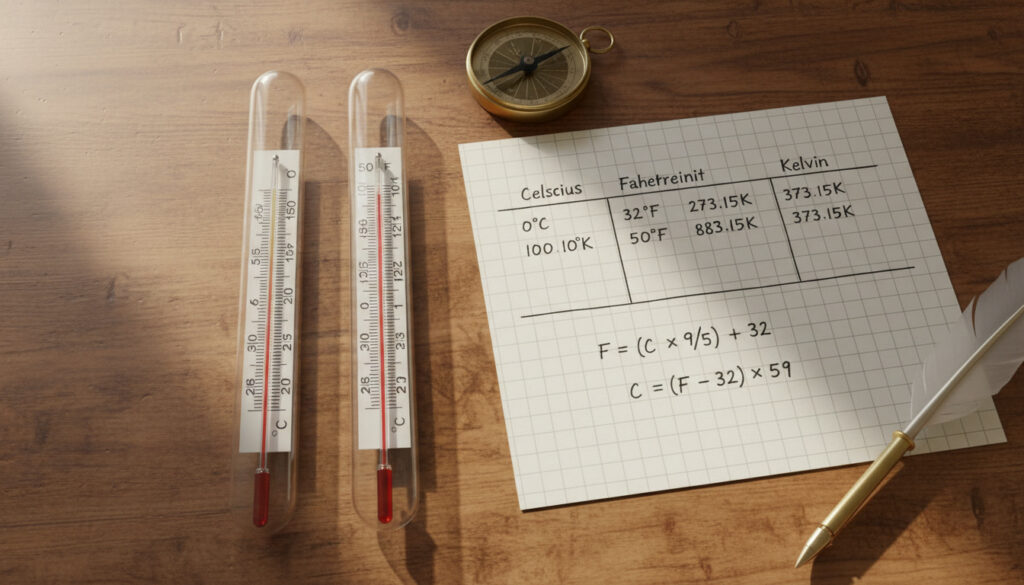
10 Celsius to Fahrenheit – Exact 50°F Formula & Table
Ten degrees Celsius converts to exactly 50 degrees Fahrenheit, a midpoint measurement that appears in weather reports, laboratory settings, and international travel guides. This specific thermal value represents a cool but not freezing environment, requiring only light insulation for comfort.
The relationship between these two temperature scales follows a precise mathematical ratio derived from the freezing and boiling points of water. While automated digital converters handle the arithmetic instantly, understanding the manual calculation method ensures accuracy when technology fails or when working with non-standard measurements.
What Is 10°C in Fahrenheit?
The direct conversion yields exactly 50 degrees Fahrenheit when starting from 10 degrees Celsius. This result emerges from the standard conversion formula accepted by metrological institutions worldwide. Mathematical verification confirms this equivalence contains no rounding errors or approximations for integer values.
10°C = 50°F
°F = (°C × 1.8) + 32
Cool, light jacket weather
50°F = 10°C
- The conversion yields an integer result with no decimal remainders
- 50°F sits precisely midway between freezing (32°F) and comfortable room temperature (68°F)
- Scientific protocols require this precision for experimental reproducibility
- Weather services use this benchmark to indicate crisp autumn conditions
- The Celsius to Fahrenheit relationship remains constant regardless of geographic location
| Celsius | Fahrenheit | Physical Context |
|---|---|---|
| 0°C | 32°F | Water freezes |
| 10°C | 50°F | Cool day |
| 20°C | 68°F | Room temperature |
| 37°C | 98.6°F | Human body |
| 100°C | 212°F | Water boils |
| -40°C | -40°F | Scale parity |
Additional conversion resources provide alternative verification methods for this specific temperature point.
How to Convert Celsius to Fahrenheit (Formula)
Converting Celsius measurements to Fahrenheit requires applying a two-step algebraic formula recognized by scientific standards organizations. The operation involves multiplication by nine-fifths followed by the addition of thirty-two degrees to account for the offset between scale zero points.
Step-by-Step Calculation for 10°C
To manually convert 10 degrees Celsius, first multiply the Celsius value by 1.8 (the decimal equivalent of 9/5). Ten multiplied by 1.8 equals 18. Calculation standards confirm this intermediate product.
Next, add 32 to this product. Eighteen plus 32 equals 50, yielding the final Fahrenheit measurement. Mathematical references document this specific arithmetic sequence for positive integer conversions.
The Mathematical Foundation
The formula derives from the defined span between water’s freezing and boiling points. Celsius establishes these at 0 and 100 degrees, while Fahrenheit places them at 32 and 212 degrees. This creates a 180-degree Fahrenheit range for every 100-degree Celsius span, producing the 9/5 ratio.
For quick estimation without calculators, add 40 to the Celsius value, multiply by 1.8, then subtract 40. For 10°C: 10 plus 40 equals 50, times 1.8 equals 90, minus 40 equals 50°F. Educational sources note this yields exact results at -40° where both scales converge.
10°F to Celsius (Reverse Conversion)
Converting 10 degrees Fahrenheit to Celsius produces a negative value significantly below the freezing point of water. The inverse operation requires subtracting 32 from the Fahrenheit value, then multiplying by five-ninths.
Exact Inverse for 10°F
Beginning with 10°F, subtract 32 to obtain negative 22. Multiplying negative 22 by 5/9 produces negative 12.222…, an infinitely repeating decimal. The standard reverse formula reads °C = (°F – 32) × 5/9, alternatively expressed as (°F – 32) divided by 1.8.
When Reverse Conversion Matters
Reverse calculations prove essential when interpreting legacy weather data, historical scientific records, or equipment specifications manufactured in Fahrenheit-dominant regions. Precision remains critical for pharmaceutical storage and chemical processing where temperature differentials affect molecular stability.
Ten degrees Fahrenheit converts to exactly -12.222… degrees Celsius, with the digit 2 repeating infinitely. For practical purposes, meteorologists often round this to -12.2°C, though scientific calculations may retain greater decimal precision.
Celsius to Fahrenheit Conversion Table
Reference tables provide immediate lookup capability for common temperature points surrounding 10 degrees Celsius. These ranges cover typical weather variations, physiological normals, and industrial benchmarks.
Table for 0-20°C
| Celsius (°C) | Fahrenheit (°F) | Conditions |
|---|---|---|
| 0 | 32 | Freezing |
| 5 | 41 | Refrigerator |
| 10 | 50 | Cool weather |
| 15 | 59 | Mild spring |
| 20 | 68 | Comfortable indoor |
Complete conversion table resources extend these values to extreme ranges for scientific and meteorological applications.
Quick Reference Chart
Extended benchmarks include body temperature at 37°C (98.6°F), boiling water at 100°C (212°F), and the convergence point at negative 40 where both scales display identical values.
Always verify calculation direction before applying formulas. Confusing Celsius-to-Fahrenheit with Fahrenheit-to-Celsius operations produces substantially different results. Ten degrees Celsius equals 50°F, while ten degrees Fahrenheit equals approximately negative 12 degrees Celsius—a critical distinction for weather interpretation and safety planning.
History of the Temperature Scales
The Fahrenheit and Celsius scales emerged from distinct historical and scientific contexts, separated by nearly two decades of 18th-century European innovation.
- : Daniel Gabriel Fahrenheit establishes his scale using brine, body temperature, and boiling water references.
- : Anders Celsius proposes his scale, initially with boiling at 0 and freezing at 100, reversed after his death.
- : International Committee adopts Celsius as part of the metric system standardization.
Modern metrology defines Celsius through the triple point of water at 0.01°C rather than simple freezing points, ensuring greater precision for scientific calibration. Historical documentation confirms these developmental trajectories.
What Is Certain About 10°C to Fahrenheit?
The conversion of 10 degrees Celsius to Fahrenheit represents established mathematical certainty with no substantive ambiguity in the scientific community.
| Established Facts | Uncertain or Variable Elements |
|---|---|
| 10°C equals exactly 50°F using standard formulas | Individual thermal comfort perception at 10°C varies by climate acclimatization |
| Mathematical formulas derive from fixed water phase points | Regional clothing recommendations for 50°F differ by humidity and wind exposure |
| Integer conversions produce no rounding errors | Historical scale definitions varied before 1954 standardization |
Is 10°C Cold? Fahrenheit Context
Ten degrees Celsius, or 50 degrees Fahrenheit, registers as cool rather than cold for most populations, though subjective interpretation varies by geographic origin and seasonal adaptation. Climatological assessments describe this range as requiring light jackets rather than heavy winter insulation.
Everyday Temperature Feel
The temperature sits comfortably above the freezing threshold of 0°C (32°F), eliminating immediate frost risk while remaining below the 20-25°C range considered optimal for indoor comfort. Regions using Celsius typically describe 10°C as brisk spring weather, while Fahrenheit-dominant areas recognize 50°F as definitive autumn coolness.
Global Usage Differences
International scientific and meteorological standards overwhelmingly favor Celsius for data reporting, consistent with the International System of Units. The United States maintains Fahrenheit for public weather communication and consumer applications, creating a persistent dual-system environment for cross-border information exchange.
Standards and Metrological Sources
The conversion between Celsius and Fahrenheit follows exact algebraic relationships defined by the interval between water’s freezing and boiling points, with 10°C representing a precise midpoint in the 0-20°C comfort range.
— Standard Metrological References
National measurement institutes recognize both scales, with Celsius serving as the SI base unit for thermodynamic temperature. Conversion formulas align with international definitions where 0.01°C corresponds to 32.018°F at water’s triple point.
Summary: 10°C in Perspective
Ten degrees Celsius converts to exactly 50 degrees Fahrenheit through the application of the standard multiplication and addition formula. This temperature represents cool but non-freezing conditions suitable for light outerwear, standing as a common reference point between the freezing and boiling markers of water. Understanding both the precise calculation method and the subjective thermal experience of this measurement aids accurate interpretation across scientific, meteorological, and daily contexts.
Frequently Asked Questions
Is 10 degrees Celsius cold?
Ten degrees Celsius (50°F) feels cool or chilly, similar to brisk autumn weather. Most individuals require a light jacket but not heavy winter clothing at this temperature.
Why use Fahrenheit vs Celsius?
Celsius serves as the international scientific standard used by most countries for weather, medicine, and research. Fahrenheit persists primarily in the United States for public weather reports and consumer applications.
What is 10 Fahrenheit in Celsius?
Ten degrees Fahrenheit equals approximately negative 12.2 degrees Celsius. The exact value is negative 12.222…°C, calculated by subtracting 32 then multiplying by 5/9.
How do you convert Celsius to Fahrenheit without calculators?
Use the mental shortcut: add 40 to the Celsius value, multiply by 1.8, then subtract 40. For 10°C: 50 times 1.8 equals 90, minus 40 equals 50°F.
What is the exact formula for Celsius to Fahrenheit?
The exact formula is Fahrenheit equals Celsius multiplied by nine-fifths plus thirty-two, or equivalently Fahrenheit equals Celsius times 1.8 plus 32.
At what temperature do Celsius and Fahrenheit match?
The two scales show identical values at negative 40 degrees. This convergence point represents the only temperature where both scales display the same numerical value without conversion.
More related posts
 Which Actor Died Today? Recent Celebrity Deaths & Updates
 Alavés vs Real Madrid – Preview Lineups Predictions
 Mounting TV Wall: Rules, Mistakes & DIY Tips
 Rogers Red World Elite Mastercard: Benefits, Fees & Rewards
 Best Exercises for Coordination: Drills for Balance & Agility
 Canadian Dollar to CFA Franc: Current Rate & Forecast
 Adam Foote: From Stanley Cup Champion to Fired Canucks Coach
 Melia Cayo Santa Maria – Resort Guide Reviews 2025