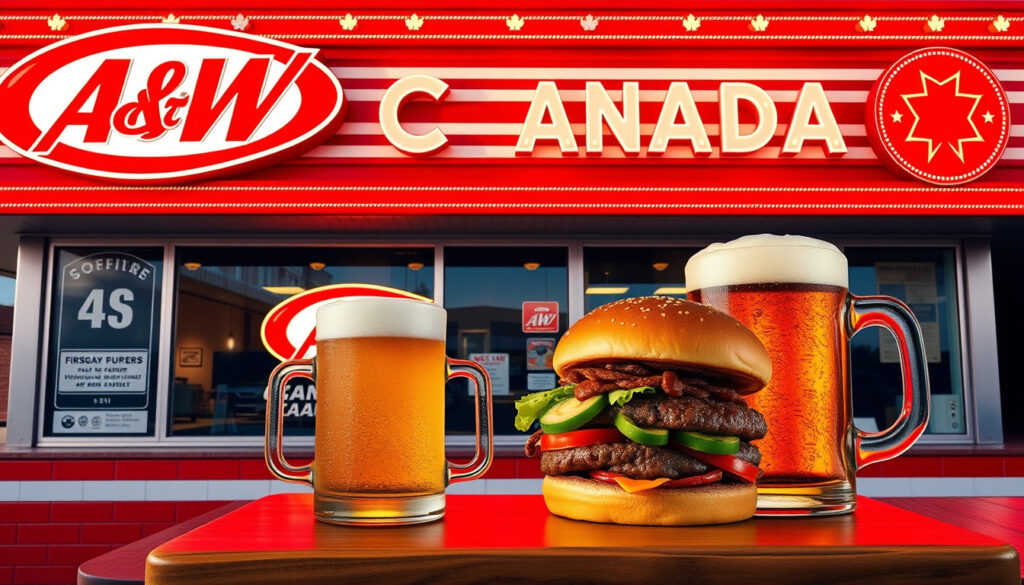
A&W Canada: Ownership, Beef, History & US Differences
A&W Canada and US A&W share a name and early-20th-century origin story, but the two chains have evolved into fundamentally different enterprises. While Roy Allen’s 1919 root beer stand in Lodi, California, birthed a brand now recognizable across North America, Canadian operations took a divergent path — separating from US ownership in 1972, completing a management buyout in 1995, and positioning itself around 100% Canadian grass-fed beef sourcing that sets it apart from its southern counterpart.
Headquarters: North Vancouver · Market Position: Canada’s second-largest fast-food hamburger chain · Company Status: Publicly traded · Instagram Followers: 91K · US Origins: Roadside stand in 1919
Quick snapshot
- Canadian operations separated from US in 1972 (Wikipedia)
- Headquartered in North Vancouver, publicly traded (Wikipedia)
- 100% Canadian grass-fed beef announced March 2024 (Canadian Cattlemen)
- Exact current ownership percentages after July 2024 NewCo announcement
- Whether the July 2024 NewCo transaction closed as expected in October 2024
- Specific popularity metrics beyond market ranking
- A&W Food Services NewCo restructuring expected to close October 2024 (Wikipedia)
- Grass-fed Canadian beef initiative rolling out across 1,050 locations (Canadian Cattlemen)
The table below summarizes the core facts about A&W Canada, from its 1956 founding to its current status as a publicly traded, Canadian-owned burger chain.
| Fact | Detail |
|---|---|
| Founded in Canada | 1956 |
| Headquarters | North Vancouver, BC |
| Ranking | 2nd largest hamburger chain |
| Beef Source | 100% Canada guaranteed |
| Ownership | Publicly traded (A&W Food Services) |
Are A&W Canada and US the same?
No — despite sharing a name and early history, the two chains are entirely separate companies today. A&W Canada became independent from US operations in 1995 when a Canadian management group of franchisees purchased the chain from Unilever, operating as a publicly traded company headquartered in North Vancouver under A&W Food Services of Canada Inc. (Wikipedia). The US chain, meanwhile, is owned by A Great American Brand, LLC — a consortium of franchisees that acquired it from Yum! Brands in December 2011 (Wikipedia A&W Restaurants).
Origins and ownership differences
The divergence began quietly in 1972 when Unilever purchased Canadian A&W franchises, formally separating them from US operations (Sodafry). While the US chain passed through multiple corporate hands — including a period under Yum! Brands — Canadian operations stayed within Unilever’s portfolio until the 1995 management buyout. This buyout transformed A&W Canada into a Canadian-owned enterprise, distinct from whatever happened to the American counterpart.
The structural split means Canadian diners aren’t experiencing a diluted version of the American brand — they’re interacting with a separately operated chain that has its own ownership incentives, sourcing priorities, and menu development strategy.
Menu and branding variations
The differences extend to what’s on the menu. A&W Canada retains the retro “Burger Family” names — Papa Burger, Teen Burger, and similar classics — that the US abandoned in the 1970s (Sodafry). Canadian locations also offer poutine, broader chicken options, veggie burgers, and breakfast platters that don’t appear on US menus (Chowhound). Even the root beer recipe differs between the two chains, reflecting decades of independent product development.
The implication: if you’re a Canadian who’s tried the US chain or vice versa, you’re essentially comparing two different restaurants that happen to share a founder story.
What does A&W actually stand for?
A&W stands for Roy Allen and Frank Wright — the two partners who joined forces in 1922 when Roy Allen, who had opened his root beer stand in Lodi, California in 1919, brought Frank Wright into the business (Paste Magazine). The name isn’t an acronym in the traditional sense — there’s no official meaning attached to the ampersand. It’s simply a partnership name that stuck.
Historical founders
Roy Allen’s timing proved fortuitous. According to historical accounts, the temperance movement was gaining momentum when he opened his root beer stand, and alcohol would become illegal nationwide in 1920 (Sodafry). The root beer business thrived in that environment. By 1923, the first A&W burger had arrived after formalizing the partnership with Wright, and by 1926, A&W had become America’s first franchise restaurant chain (Wikipedia A&W Restaurants). Roy Allen retired in 1950 with approximately 450 franchise locations under the brand’s belt.
No official acronym meaning
Despite various fan theories and playful interpretations, A&W has never officially designated a meaning for the ampersand beyond being part of the founders’ partnership name. The brand itself leans into this ambiguity — there’s no corporate messaging pushing a specific interpretation, and the simplicity of the name has arguably become part of its nostalgic appeal.
The pattern: two partners, one ampersand, a century of brand equity built on root beer and burgers — no acronym required.
Is A&W 100% Canadian owned?
Yes — A&W Canada is Canadian-owned and operated. The chain is owned by A&W Food Services of Canada Inc., a publicly traded company headquartered in North Vancouver, British Columbia (Wikipedia). The company has expanded to 1,050 restaurants coast-to-coast, all Canadian owned and operated (A&W Canada Official).
Current ownership structure
A&W Canada’s corporate structure involves publicly traded shares and royalty income funds. The A&W Revenue Royalties Income Fund listed on the Toronto Stock Exchange on February 15, 2002, creating a mechanism where the company collects royalties from franchisees and distributes them to investors (Wikipedia). This structure gives the company access to public capital markets while maintaining Canadian operational control.
A July 2024 NewCo restructuring announcement could alter ownership dynamics — whether this transaction closed as expected in October 2024 remains unclear from publicly available information.
Publicly traded status
The publicly traded status differentiates A&W Canada from many fast-food franchisors. Rather than being absorbed into a larger corporate parent, the company operates as a Canadian public entity with its own shareholder accountability. This structure gives investors direct exposure to A&W’s Canadian performance rather than bundling it with other brands.
What this means: Canadian investors can buy A&W stock; the company files with Canadian regulators; and its financial performance is tracked independently of any American corporate parent.
Is A&W 100% Canadian beef?
Yes — A&W Canada made a significant announcement in early March 2024, committing to 100% grass-fed Canadian beef sourcing (Canadian Cattlemen). This builds on the company’s existing commitment to source beef raised without hormones and to use the Canadian supply chain for beef, chicken, and potatoes (A&W Canada Official).
Beef sourcing guarantee
The grass-fed initiative represents a meaningful expansion of A&W Canada’s Canadian sourcing commitment. According to industry reporting, the company committed millions more pounds of Canadian beef through this program (Canadian Cattlemen). The program accepts cattle under 5 years of age with limits on concentrate feed — a standard that goes beyond simply being “Canadian” to addressing how the cattle are raised.
Switching to Canadian-only grass-fed cattle under 5 years creates a more restrictive supply chain that could face sourcing challenges during periods of tight domestic cattle supply.
Partnerships like Cargill
A&W Canada has partnered with suppliers like 98 Ranch to fulfill its grass-fed commitments (Wikipedia). The company has also engaged in nature-based solutions through partnerships like ALUS (Agricultural Land Use Stewardship), which supports sustainable agricultural practices among Canadian ranchers. An A&W representative noted that these commitments had already driven millions of pounds of additional Canadian beef purchasing — described as “a big positive” for domestic cattle producers (Canadian Cattlemen).
The implication: Canadian cattle ranchers have a direct commercial stake in A&W Canada’s menu performance — every burger sold domestically contributes to domestic beef demand rather than imports.
Is A&W popular in Canada?
By the numbers, yes — A&W Canada ranks as the country’s second-largest hamburger chain, trailing only McDonald’s (Wikipedia). The chain operates 1,029 franchises as of 2022, with the count having grown to approximately 1,050 locations coast-to-coast (A&W Canada Official). This scale alone suggests meaningful consumer demand and brand recognition across the country.
Market ranking
The contrast with US A&W is striking. While Canada’s chain has grown to over 1,050 locations, US A&W dropped from 634 locations in 2017 to 460 in 2024 (Chowhound). The divergent trajectories reflect different competitive environments, corporate strategies, and — given A&W Canada’s menu localization and Canadian beef commitments — perhaps different alignment with local consumer preferences.
Customer reviews and presence
The Toronto flagship location carries a 3.8/5 rating based on customer reviews, suggesting solid but not exceptional performance at a high-traffic urban site (Wikipedia). Broader popularity metrics — like customer frequency surveys, brand sentiment indices, or regional sales data — aren’t readily available in public sources, leaving some uncertainty about how market share translates to actual dining frequency.
The pattern: strong market presence and ranking, but limited public data on deeper engagement metrics.
This comparison highlights the divergent paths of the two chains across ownership, scale, menu, and sourcing.
| Metric | A&W Canada | A&W US |
|---|---|---|
| Locations (recent) | 1,050 (A&W Canada Official) | 460 (Wikipedia) |
| Locations (2022/2017) | 1,029 franchises (Wikipedia) | 634 (2017 baseline) (Chowhound) |
| Market ranking | 2nd largest hamburger chain (Wikipedia) | Mid-tier US burger chain |
| Ownership | Publicly traded, North Vancouver (Wikipedia) | Franchisee consortium (Wikipedia) |
| Menu highlights | Poutine, veggie burgers, breakfast, Burger Family (Chowhound) | Limited menu, Rooty mascot focus (Sodafry) |
| Beef sourcing | 100% Canadian grass-fed (Canadian Cattlemen) | Standard US sourcing |
Clarity on what we know and what remains uncertain
Confirmed
- Canadian beef guarantee per official site — 100% Canadian, hormone-free (A&W Canada Official)
- Publicly traded in Canada, listed on Toronto Stock Exchange since 2002 (Wikipedia)
- Separate from US operations since at least 1995 management buyout (Wikipedia)
- 1,050 locations coast-to-coast, all Canadian owned and operated (A&W Canada Official)
Unclear
- Exact current ownership percentages after July 2024 NewCo announcement
- Whether October 2024 NewCo closing occurred as announced
- Detailed popularity metrics beyond market ranking — no public frequency or sentiment data
Timeline: From 1919 to Today
Four key dates illustrate how A&W Canada diverged from its American counterpart and built an independent identity.
| Date | Event |
|---|---|
| 1919 | Roy Allen opens root beer stand in Lodi, California (Sodafry) |
| 1956 | First Canadian A&W opens in Winnipeg, Manitoba (Wikipedia) |
| 1972 | Unilever purchases Canadian A&W franchises, formally separating them from US operations (Wikipedia) |
| 1995 | Canadian management group buys A&W Canada from Unilever (Wikipedia) |
| 2002-02-15 | A&W Revenue Royalties Income Fund lists on Toronto Stock Exchange (Wikipedia) |
| 2011-12 | US A&W sold to franchisee consortium (Wikipedia) |
| 2024-03 | 100% Canadian grass-fed beef announced (Canadian Cattlemen) |
| 2024-07-22 | A&W Canada announces strategic NewCo combination (Wikipedia) |
The timeline reveals a consistent pattern: Canadian operations have repeatedly chosen independence over integration with American corporate structures. From the Unilever separation to the 1995 buyout to the 2002 public listing, each step reinforced Canadian control — culminating in the 2024 NewCo announcement that suggests the company is still actively reshaping its corporate form.
What Experts and Insiders Say
“Those commitments had us buying millions more pounds of Canadian beef, so that in and of itself I think is a big positive.”
— Senecal, A&W Canada representative, Canadian Cattlemen
“A&W didn’t ‘fit into [its] long–term growth strategy.'”
— Yum! Brands CEO, explaining the 2011 sale of US A&W to franchisees (Chowhound)
“Roy had impeccable timing because the temperance movement was gaining momentum and alcohol would become illegal in 1920.”
— Historical analysis from Sodafry
The divergence in how the two chains are perceived is striking. While US A&W was quietly shed by a major corporation as non-strategic, Canadian operations have positioned themselves around domestic sourcing commitments that generate positive media coverage and consumer goodwill. Whether that positioning translates to sustained competitive advantage depends on factors including execution of the grass-fed initiative and continued Canadian beef supply availability.
Summary
A&W Canada and US A&W may share a name and early-20th-century origin story, but they’ve evolved into fundamentally different enterprises. Canada’s chain chose independence over corporate integration — first from Unilever, then through a public listing that kept ownership in Canadian hands. That structural choice enabled the company’s current positioning around 100% Canadian grass-fed beef, a menu that differs markedly from the US version, and coast-to-coast expansion that now outpaces the American counterpart by more than two-to-one in location count. The July 2024 NewCo announcement suggests the company isn’t finished reshaping its corporate structure — but the direction of travel since 1972 has been consistently toward greater Canadian autonomy, not less.
For Canadian consumers, the practical takeaway is straightforward: when you order at an A&W in Canada, you’re supporting a Canadian-owned chain that sources beef from Canadian ranchers under Canadian standards, with a menu designed for Canadian palates. Whether that matters enough to choose A&W over competitors depends on how much you value local sourcing and independent ownership in your fast-food dining.
Related reading: Alimentation Couche-Tard history · Sirloin tip roast recipe
Frequently asked questions
Which is older, McDonald’s or A&W?
A&W is older. The chain traces its roots to 1919 when Roy Allen opened a root beer stand in Lodi, California. McDonald’s was founded in 1940 (as the McDonald brothers’ restaurant) with the first franchised McDonald’s opening in 1955. By 1930, A&W had already expanded to over 100 US locations.
What is on the A&W Canada menu?
A&W Canada’s menu includes the Burger Family lineup (Papa Burger, Teen Burger, and similar), root beer, poutine, broader chicken options, veggie burgers, and breakfast platters. The chain retains menu items like Papa Burger that the US version dropped in the 1970s.
Where are A&W Canada locations?
A&W Canada operates approximately 1,050 locations coast-to-coast, from British Columbia to Newfoundland. The chain is headquartered in North Vancouver, British Columbia.
Who owns A&W Canada?
A&W Canada is owned by A&W Food Services of Canada Inc., a publicly traded company. The A&W Revenue Royalties Income Fund listed on the Toronto Stock Exchange in 2002. On July 22, 2024, the company announced a strategic combination to form A&W Food Services NewCo, expected to close in October 2024.
Are there A&W Canada coupons available?
A&W Canada periodically offers promotions and coupons through its website and mobile app. For current offers, check the official A&W Canada website or mobile application.
What careers are available at A&W Canada?
A&W Canada offers franchise and corporate career opportunities across its 1,050 locations. As a publicly traded company with ongoing corporate restructuring, specific career opportunities change over time. Check the A&W Canada careers page for current openings.
What are A&W Canada specials?
A&W Canada specials vary by season and location. The chain frequently offers value menus, combo deals, and limited-time items. The 2024 grass-fed Canadian beef initiative represents the most significant menu-related announcement in recent years.
More related posts
 Voyage Organisé New York – Prices, Agencies and Booking Guide
 Us Visa Integrity Fee – Amount, Affected Visas, Start Date
 Cast of Only Murders in the Building – Complete Seasons 1-5 Roster
 Why Is the TSX Down Today? Live Updates & Key Reasons
 Great Wall of China: Length, History, Facts & Myths
 Canadian Dollar Value: Live CAD Rates USD EUR Today
 How to Book a Family Doctor Appointment Online in France
 Wyndham Garden Winnipeg Airport: Amenities, Reviews & Location